 NINJA IDLE
Sign in
NINJA IDLE
Sign in
Combat
How a fight works
The mission screen is the stage: your squad keeps fighting there while you work in any other menu. Only the leader fights and earns XP; supports lend stats and never step into the field.
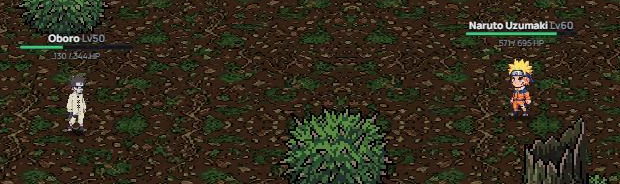
Fights run in turns, and in each turn whoever has more Speed acts first. On a tie the leader goes first.
- Combat HP is ×8 the HP on the card, so a fight lasts an exchange of blows instead of a single hit.
- Each turn burns 2.5 seconds of move cooldown. On a mission the clock is real time, so the seconds written on a move are actual seconds.
- A fight runs for at most 200 turns. If the enemy is still standing at the end it counts as a loss, not a draw.
The six stats
Every ninja, yours or an enemy, has the same six stats.
| Stat | What it does |
|---|---|
| HP | How much the ninja can take. In combat it counts as ×8 the number on the card. |
| Attack | Feeds the damage of Taijutsu moves. |
| Defense | Cuts the Taijutsu damage you take. |
| Chakra Attack | Feeds the damage of Ninjutsu and Genjutsu moves. |
| Chakra Defense | Cuts the Ninjutsu and Genjutsu damage you take. |
| Speed | Decides who acts first in the turn. |
The Power on the card is a summary of all six, weighted by Potential. It is there to compare two ninjas at a glance, but it is not what enters the damage math: what enters is the stat pair of the move's category.
The damage math
Every move that connects goes through this:
tactical = element advantage × category advantage, capped between ×0.6 and ×1.8
damage = move power × ratio × tactical
- The stat pair comes from the move's category: Taijutsu uses Attack against Defense, while Ninjutsu and Genjutsu use Chakra Attack against Chakra Defense.
- Kekkei Genkai, equipment, supports and formation do not show up in the formula because they are already baked into the stats.
- Minimum damage is 1. A move that connects never deals zero.
Elemental advantage
The five elements form a cycle: each one beats the next and loses to the one before it.
| Element | Beats | Loses to |
|---|---|---|
| Fire | Wind | Water |
| Wind | Lightning | Fire |
| Lightning | Earth | Wind |
| Earth | Water | Lightning |
| Water | Fire | Earth |
Advantage multiplies damage by ×1.5, disadvantage by ×0.7. Elements with no relation in the cycle change nothing.
Jutsu categories
On top of the element, every move has a category, and categories form a cycle of their own.
| Category | Beats | Stats it uses | Range |
|---|---|---|---|
| Taijutsu | Genjutsu | Attack against Defense | 1 |
| Genjutsu | Ninjutsu | Chakra Attack against Chakra Defense | 5 |
| Ninjutsu | Taijutsu | Chakra Attack against Chakra Defense | 3 |
Category advantage is worth the same ×1.5 and ×0.7 as the elemental one, and the two multiply. Together they never go past ×1.8 nor below ×0.6, so hitting both cycles at once is great but does not double your damage. The range in the last column is how far the move is thrown on the stage, and it does not enter the damage math.
The enemy's level
A higher level enemy is not just stronger on paper: its stats are multiplied by a ladder that climbs 1.8% per level of difference. At your leader's own level the enemy already counts as ×1.3.
| Enemy level | Its strength | In practice |
|---|---|---|
| -40 | ×0.06 | drops in one hit |
| -30 | ×0.22 | drops in one hit |
| -20 | ×0.91 | almost an even match |
| -10 | ×1.09 | one Medical Kit covers it |
| 0 | ×1.3 | a real fight |
| +10 | ×1.55 | you will need several Kits |
| +20 | ×1.86 | out of reach for now |
From 20 levels below you the ladder falls off on purpose, and that is the band where your leader clears a mission in one hit. The ladder only applies against enemies: in the Arena, player against player, it does not.
Moves, cooldowns and combo
Each ninja carries 3 moves of your choosing, plus the Ultimate on forms that have one. The order of the slots is the order they come out in the field.

- A move's power comes from the character's scale in its current form and from the weight of the move itself. Leveling up does not thicken the move from the outside: what grows is the ninja.
- Every move has its own cooldown, written in seconds. With no cooldown of its own, a regular move waits 4s and an Ultimate 10s.
- A heavy move hits far harder and comes back far slower, a light one keeps the pressure up. A good combo alternates them instead of stacking only the heavy ones.
- Some moves do more than damage: they stun, grant dodge for a few turns, or heal.
Sieges: several enemies at once
On a mission you do not face one enemy at a time but its whole line: they walk in together and, as they fall, reinforcements arrive. Every kill pays XP, loot and Chakra Fragments right away.
Healing in combat
Your leader uses a Medical Kit on its own, if you let it.
- The Kit restores 40% of combat HP and spends the turn's action.
- It fires when HP drops below the threshold you choose, from 0 to 90%. The threshold starts at 0, which means off.
- The cap is 5 Kits per fight, no matter how many you are carrying.
When your squad loses
Losing costs you no ninja and no item: the squad goes back to the village, rests 30s before it can return to the field, and comes back at full HP. The same clock applies when you are the one pulling the squad off a mission.